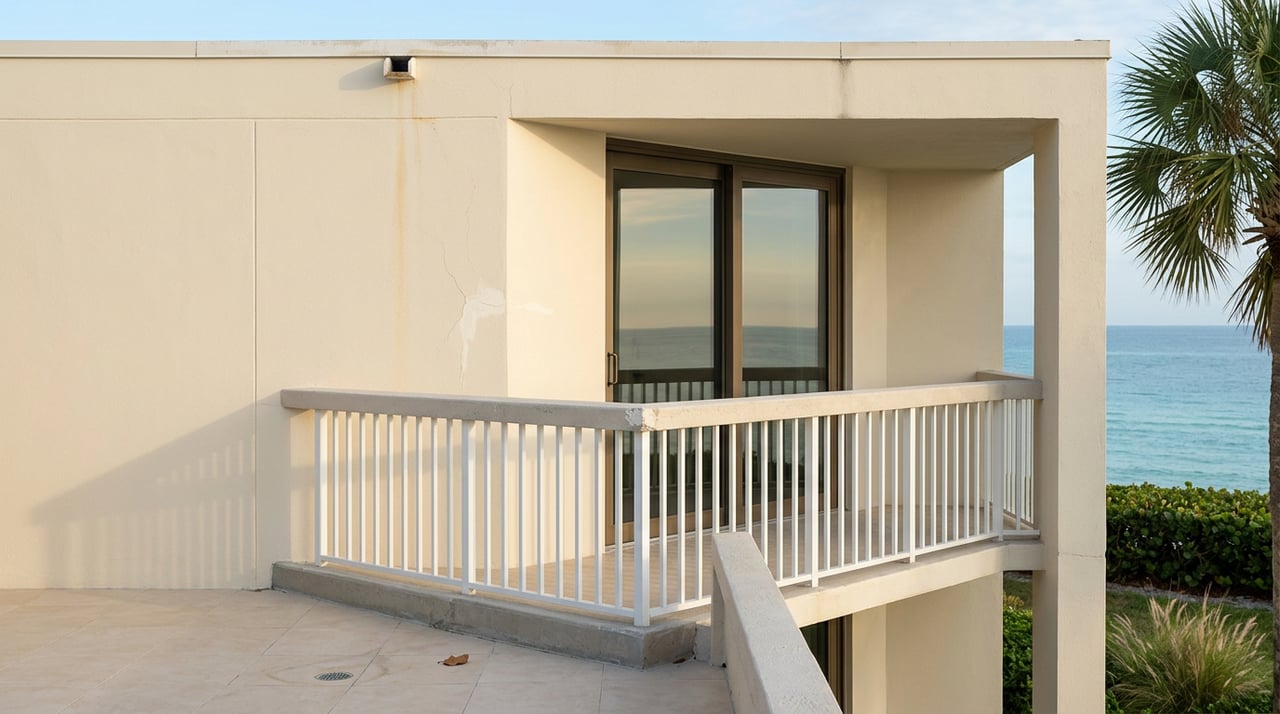
Why Siesta Key Condo Prices Are Splitting by Decade, Not by View
August 20, 2026
August 20, 2026
When Hurricane Helene pushed floodwater across Siesta Key in the fall of 2024, the surge reached Harbor Towers Yacht and Racquet Club almost exactly as forecasters predicted. What the forecasters could not have predicted is that the 210-unit waterfront community would come through the storm season relatively unscathed, because the timing of a $14 million renovation happened to land just right. Crews had wrapped a two-year exterior overhaul, replacing windows, sliding glass doors, and much of the building's stucco, in mid-August, weeks before Helene arrived. General manager David Krause put it simply: saltwater covered 80 percent of the property, but the scaffolding was already down and the crews were already gone.
That timing was not luck. It was a special assessment the building's owners approved back around 2019, years before Florida law required anything like it. Down the street and across the island, plenty of other buildings did not get ahead of the same math, and now the math has become mandatory rather than optional. As of January 1, 2026, Florida condominium associations in buildings three stories or taller can no longer vote to waive or defer funding for structural reserves. The bill that used to come whenever a board felt like paying it now comes on a schedule set by state law, and it has already started reshaping what a Siesta Key condo is worth before either party sits down at the closing table.
Most owner-controlled Florida condo associations that existed before July 2022 were required to complete their first Structural Integrity Reserve Study by December 31, 2025. That study, mandated under Senate Bill 4-D and refined by SB 154 and House Bill 913, covers eight structural components: the roof, load-bearing structure, fireproofing and fire protection, plumbing, electrical systems, waterproofing and exterior paint, windows and exterior doors, and any other item over the state's inflation-adjusted threshold (set at $25,675 for 2026) that affects those systems. A narrow exception lets a building coordinate its study with a milestone inspection due on or before December 31, 2026, but the law is explicit that a structural integrity reserve study cannot be completed after that date under any circumstance.
For buyers and sellers, the part that actually matters is what happened after the study got filed. Once a building's reserve study is on record, the association can no longer vote to underfund or skip the structural line items it identifies. The dues, or the special assessment that replaces them, become close to unavoidable. That is the mechanism behind Harbor Towers' quiet confidence. It is also the mechanism behind every headline about a six-figure assessment landing on unsuspecting owners in older Florida buildings, because those buildings deferred the same funding for decades under the old rules, which allowed waivers with a simple majority vote.
Ask five agents on the island what to check before making an offer on a condo, and four of them will say "the reserve study." The number inside that study that actually tells you something is the percent funded figure, meaning how much of the projected structural repair cost the association currently has in the bank relative to what it should have.
| Percent Funded | What It Signals | What a Buyer Should Expect |
|---|---|---|
| 70% or higher | Reserves are tracking with the funding plan | Routine dues increases, low odds of a surprise assessment |
| 30% to 70% | Partially funded, catching up | Measured dues increases likely over the next few years |
| Under 30% | Reserves are materially behind schedule | A special assessment is a realistic near-term outcome |
Siesta Key's condo stock spans both ends of that table inside the same square mile. Gulf & Bay Club, the six-building, roughly 391-unit community on Crescent Beach, was built between 1979 and 1986, which means every building in it fell squarely under the 2025 SIRS deadline. Newer construction such as One88 and Beach Residences was built recently enough to sit outside the milestone and reserve-study window for another two to three decades. Same island, same beach, and a completely different funding clock ticking underneath the sale price.
"My goal as a manager has always been 'no special assessments,'" Krause told Siesta Sand after Harbor Towers' renovation wrapped. "If you do it right, when it's time to do something like replace the roof, the money is in the bank."
That is the sentence every buyer touring a 1970s or 1980s Gulf-front building on Siesta Key should be able to say back to their agent with confidence, one way or the other, before they write an offer.
The listing sheet will not tell you where a building sits on that table. The association will, but only if you ask for the right documents at the right moment. On any Siesta Key condo, whether it is a bay-side building near the marina or a Gulf-front tower on Midnight Pass Road, request these before your inspection period closes:
Meeting minutes matter more than most buyers expect. A pending seawall repair or a "deferred to next quarter" line item almost always shows up there months before it shows up as a bill. Florida's most recent condo reforms also gave buyers a real window to act on what those documents reveal: purchasers now have seven days to review a building's financial and inspection records before they are bound to the purchase agreement, a meaningful improvement over the tighter timelines that used to leave buyers little room to walk away after a late discovery.
The seven-day buyer review window cuts both ways. Sellers of older Siesta Key buildings now have less room to let a pending assessment surface quietly during due diligence, because a well-advised buyer will find it inside that window and use it to renegotiate or exit. The practical answer is to get ahead of it the way Harbor Towers' board did years before the law required it: have the reserve study, the funding plan, and the insurance declarations organized and ready before the listing goes live, not after an offer comes in.
Sellers whose building already completed its SIRS with a healthy funding percentage have a genuine selling point, one that a like-for-like unit two buildings down the street may not be able to match. That is a real differentiator worth featuring in a listing, not just a compliance checkbox to mention if asked.
Does this apply to single-family homes or villas on Siesta Key? No. Milestone inspections and Structural Integrity Reserve Studies apply only to condominium and cooperative buildings three or more habitable stories in height. A single-family home or a villa governed by a homeowners association under Chapter 720 is not subject to these rules, though those associations still face their own reserve planning decisions.
What if a building already did the work, like Harbor Towers? Ask anyway. A completed renovation does not automatically mean the reserve accounts are refilled. The SIRS funding plan will show whether the association is rebuilding its reserves for the next cycle or still catching up from the last one.
Can I still back out if I find something concerning in the documents? That depends on how your contract is written and when you find it. This is exactly the kind of contingency language worth getting right before you sign, which is where having an agent who reviews these documents as a matter of routine, rather than as an afterthought, makes a real difference.
Siesta Key's Gulf-front buildings and its bay-side low-rises were built in the same decades, sit a few hundred yards apart, and are now on two very different financial paths because of a law that took full effect this year. Reading that difference correctly, building by building rather than by island-wide averages, is the part of a Siesta Key condo purchase that a good agent should already know cold.
If you are weighing a Gulf-front unit against a newer build, or getting ready to list a condo and want the reserve story told clearly, Team Dunn FL works these buildings block by block. Start Your Sarasota Search whenever you are ready to look at the documents, not just the view.
Stay up to date on the latest real estate trends.

Reach out to Team Dunn for expert real estate services. Buy, sell, or rent properties with confidence. Contact us today!